Showing posts with label China-US relations. Show all posts

Thursday, 4 July 2024

Resurrecting Orphans of Cold War

 Is the US trying to revive the Tibetan autonomy issue as part of its new Cold War against China?

Col R Hariharan | June 3, 2024

https://www.c3sindia.org/post/resurrecting-orphans-of-cold-war-col-r-hariharan

Courtesy: The Hindu


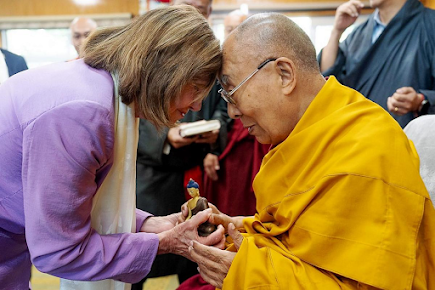
The Chinese dragon turns into a frenzy when other countries talk about Tibet or Tibetan identity and religion; and it breathes fire when anyone refers to the Dalai Lama, the spiritual leader of Tibetans. The recently passed US House of Representatives bipartisan bill that questions China’s control over Tibet seems to have achieved both the reactions. ‘The Promoting a Resolution to the Tibet-China Dispute Act’ is awaiting President Baiden’s signature. The Resolve Tibet Act, as it is referred to in short, seeks to promote a dialogue between the Chinese government and the Dalai Lama. It also empowers State Department officials to actively and directly counter ‘disinformation’ about Tibet from the Chinese government and reject false claims that Tibet has been part of China since “ancient times.” It pushes for negotiations without preconditions between the Chinese government and the Dalai Lama’s representatives. To add to China’s agony, close on the heels of the passing of the Resolve Tibet Act, a bipartisan US congressional delegation, led by House Foreign Affairs Committee chairman Michael Mc Caulis visited Dharamsala, the seat of Tibetan government in exile and met with Tibetan representatives. The delegates also called upon the Dalai Lama. Mc Caulis presented the Dalai Lama with a framed copy of The Resolve Tibet Act. Tibetans gave a public felicitation to the delegates after their meeting with the Dalai Lama. Former speaker Nancy Pelosi, member of the delegation addressing the gathering said “this bill is a message to the Chinese government that we have clarity in our thinking and our understanding of this issue of the freedom of Tibet.” After Pelosi said the Dalai Lama “with his message of compassion…and love, will live a long time and his legacy will live forever”, she fired a broadside at Chinese President Xi Jinping. She said “you will be gone and nobody will give you credit for anything.” The US delegation went on to New Delhi to meet with Prime Minister Narendra Modi. A few days ago, the Dalai Lama, aged 88, flew into New York to a warm welcome by hundreds of Tibetans. The Buddhist leader, visiting the US after 17 years, will be undergoing treatment for his knees. It is not clear whether the spiritual leader will meet any US officials during his visit. The US delegation’s visit to Dharamsala and meeting with the Dalai Lama and their promotion of the Resolve Tibet Act has drawn global attention to the Tibetan issue, which was almost forgotten. The publicity surrounding the Dalai Lama’s trip to the US has further infuriated Beijing. China minced no words in condemning the US Act and asked President Joe Biden not to sign it. Chinese foreign ministry spokesman Lin Jian told reporters “Any one or any force who attempts to destabilise Xizang (China’s official name for Tibet) to contain or suppress China will not succeed.” He called it a sovereignty issue and added “The US should not sign the bill. China will take resolute measures to defend its sovereignty, security and development interests.” Lin said Xizang was now enjoying a tranquil and harmonious society, positive economic growth and has opened up new grounds for long term stability and high-quality development. The American move on Tibet is making China highly uncomfortable. Is America trying to resurrect the Tibet autonomy issue as part of the Grey Warfare brewing for some time to cut down President Xi’s efforts to create a Sino-centric world order? It took the PRC three decades to bring Tibet under its full control. At the height of the Cold War, between 1950 and 1972 the Central Intelligence Agency (CIA) in close cooperation with the Departments of State (DoS) and Defense (DoD), conducted a comprehensive covert action campaign in support of Tibetan resistance movements fighting against Communist Chinese occupation of their homeland. The campaign’s stated goal was “to keep the political concept of an autonomous Tibet alive within Tibet and among several foreign nations.” Its similarity to the objective of The Resolve Tibet Act must be making China nervous. During the covert action, the CIA strengthened various isolated Tibetan groups to fight against the Chinese. It trained and raised a paramilitary force of 2000 Tibetans in the border areas of Nepal. During this period, the Dalai Lama and some 80 supporters fled to India on March 31,1959. India welcomed the spiritual leader and his supporters and offered them a home in Dharamsala. Since then, his presence across the border of Tibet acts as a beacon for Tibetans, who are slowly losing their culture and identity under Han hegemony. During the period of CIA intervention, some 87,000 Tibetans and 2,000 Chinese troops were killed. Over 100,000 Tibetans fled as refugees to India, Nepal, and Bhutan during the conflict. Revival of the Tibetan issue by the US will revive the bitter memories of the war of liberation, probably hidden from the younger generation of Tibetans. Tibetan government in exile estimates 1.2 million Tibetans -representing one fifth of the population - died due to China’s policies. Over 6000 monasteries, temples and historic buildings were destroyed. Thousands were arrested and suffered in prisons and labour camps. Another estimate suggests that more than 456,000 Tibetans were annihilated in the active conflict period between 1956 and 1962. In August 2020, President Xi in a speech said it is “necessary to actively guide Tibetan Buddhism to adapt to the socialist society and promote Sinicization of Tibetan Buddhism. In July 2021, Xi visited Tibet for the 70th anniversary of Tibet’s peaceful liberation. He emphasized the need to Sinicize Tibetan Buddhism and strengthen Tibetans’ identification with China and its culture. Sinicization of Tibetan Buddhism is an oxymoron as without Tibetan identity, language and culture the religion will not exist. Already, young Tibetans in China are losing touch with Tibetan language and culture as Tibet is swamped by Hans. Any foreign intervention could jeopardise Xi’s Sinicization plans. Since Xi Jinping came to power in 2012, China’s focus on Tibet’s border security and infrastructure has intensified. In particular, the infrastructure development of border areas with India has been taken up in a big way, perhaps to buttress his claims to Arunachal Pradesh, which China identifies as South Tibet. This includes the construction of 624 border defence villages. In the 14th Five Year Plan (2021-25), China has allocated 190 billion Yuan (about $29.3 billion) for infrastructure development in border regions. This includes civil and military infrastructure, roads, railways, expressways and airports. Already tightening of the border security measures has seen a drop in the number of Tibetans crossing the border as refugees, from 753 Tibetans in 2011 to five in 2022. China is unlikely to respond to the revival of any talks with the Dalai Lama and his representatives. Nine rounds of dialogues were held between them from 2002 to 2010. They did not yield concrete results. China insists on talking to the Dalai Lama’s representatives and not the representatives of the Tibetan government in exile based in Dharamsala. China also wants the Dalai Lama to “fundamentally reflect on and thoroughly correct his political views.” The Dalai Lama is not in good health and there is talk of choosing his successor in the air. The Chinese are likely to stall any American pressure to resume talks, till they choose a successor to the Dalai Lama. The CIA’s Tibet intervention ended in 1972 when POTUS Nixon wanted to recast US relations with China. The Dalai Lama in his 1991 autobiography Freedom in Exile has criticized the CIA for supporting the Tibetan independence movement not because they (the CIA) cared about Tibetan independence, but as part of their worldwide efforts to destabilize all communist governments. Given this background, the Tibet issue has the potential to become a talking point in the American presidential election debates in the next few months. The US is locked in the Ukraine conflict and in the South China Sea confrontation with China. It may not find the time and energy to revive the Tibetan intervention except as a potential threat to further unnerve the Chinese. John Kenneth Knaus, one of the CIA operatives who participated in the Tibetan resistance to fight China, aptly titled his memoir Orphans of the Cold War in sympathy for the plight of Tibetans. They have not only lost their independence, but also are in danger of losing their identity. India is in a unique position as any threat of American intervention can serve as an incentive for China to build better relations with India.Can India which has given refuge to the Dalai Lama and thousands of Tibetan refugees do more? I hope our political leadership ponders over this and factor it in India’s China policy. Col R Hariharan is a retired MI specialist on South Asia and Indian Ocean Region. He is associated with the Chennai Centre for Chin Studies. E-mail haridirect@gmail.com Website https://col.hariharan.info

Tuesday, 22 October 2019

China, like US, is not dependable and trustworthy'


Courtesy: Rediff.com/News/October 18, 2019

'Only when China treats India as an equal can we consider them real friends.'

Was the second informal meeting between Prime Minister Narendra Damodardas Modi and Chinese President Xi Jinping successful?
"The 'unequalness' in the India-China relationship is partly due to our conduct. We are not vision-driven like China," Colonel R Hariharan, an associate with the Chennai Centre for China Studies, tells Rediff.com's Shobha Warrier.
What impact will the informal meeting have on the India-China relationship?
If I were to rate the meeting, I will give it 3/5. The meeting was cordial. Both leaders met in a friendly atmosphere and discussed long term strategic issues of global and regional importance.
The informal meet was able to repair the slightly fractured relationship after China's conduct at the UN security council in support of Pakistan after India abolished Article 370.
After Imran Khan met Xi in China on October 9, Xi said China would continue to firmly support Pakistan on issues concerning its core interests and of major concern to it.
Normally, China uses the words 'core interests' when it refers to territory. For example, China uses 'core interests' in case of reference to Taiwan, Tibet and Hong Kong.
This is the first time Xi has used the term 'core interests' in relation to Pakistan.
China has made contrarian statements on the Kashmir issue, not only now but in the past also. It has said it should be settled bilaterally as also settling through the UN etc.
But this time, before the informal summit, India took pains to explain to China that abolishing of Article 370 was an internal matter, related to amending the Constitution.
After this explanation, China went to the UN security council to help Pakistan out, though no resolution on Kashmir was brought as it could not muster adequate support.
That itself showed China was favouring Pakistan on Kashmir. After that the Chinese ambassador in Pakistan made a very serious statement in support of Pakistan.
Xi's use of the term 'core interest' shows China has taken a position to support Pakistan.
India, unhappy with the development, had sent another strong signal by participating in the ministerial level meeting of the US, Australia, Japan and India to formalise the Quadrilateral alliance, which had been a loose network to formulate collective strategies in the Indo-Pacific.
These developments sent negative vibes before the meeting, just like what happened after the Doklam standoff before the Wuhan meeting. The external affairs ministry in a statement said Kashmir was an internal matter and India would not like any external interference.
So Xi probably thought Modi might bring it up Kashmir issue at the informal summit.
Do you feel Modi deciding not to raise the Kashmir issue is to India's credit?
Modi did the right thing by not raising the Kashmir issue after maintaining it was an internal issue. And the comfort level for Xi increased when Modi did not raise the issue.
India had also kept quiet about Hong Kong.
So, you can say India while being firm, took a number of measures to improve the comfort level between the two leaders.
China noticed the signals. The mood of the leaders at the meeting was quite good, enabling them to cordially discuss larger issues.
It seems trade and trade deficit dominated the summit. Does that mean Modi and Xi considered trade as the most important issue to discuss?
I will view it slightly differently. The same subject came up at Wuhan also. After the Wuhan meeting China agreed to India's export of sugar and non-Basmati rice.
In the current year, our exports to China have slightly gone up though still (it is) low. Imports have also come down.
Perhaps encouraged by this, the two sides discussed trade issues and agreed to setting up a high level mechanism headed by Finance Minister Nirmala Sitharaman and Chinese Vice Premier Hu Chunhua to look in detail at trade, investment and services. So, there is hope that there would be positive gains.
Against the background of the US-China trade war, would China be looking at India as a huge market? Would India also want to have a share in the huge Chinese market?
Exactly. The problem is China restricts imports from India. For example, in the pharmaceutical industry, though India imports organic chemicals for manufacture of drugs from China, China does not allow the import of Indian drugs.
China wants India to join the Regional Comprehensive Economic Partnership free trade agreement between the 10 member States of the Association of Southeast Asian Nations and its six FTA partners (China, Japan, India, South Korea, New Zealand and Australia).
India has been negotiating hard on the terms as it could result in Chinese imports going up. This issue also came up at the summit.
There was a lot of emphasis on trade. There was an effort on India's part to create a congenial atmosphere to take these issues forward. Issuing long term visas for the Chinese is one such effort.
Chinese tourists are not coming in large numbers to India unlike Sri Lanka where they top the number of foreign tourists. There is a great opportunity for India in promoting tourism.
Many experts say China cannot be trusted.
Personally, I am of the opinion that no nation should trust any other nation 100%.
In the case of China, it has more meaning. India has very close defence relations with both France and Russia and both have proved they are dependable. Though Russia has sold weapons and France sold submarines to Pakistan, we can trust them.
But China, like the US, is not dependable and trustworthy.
China is brazenly self-centred. China is probably the only country which has gone to war with almost all of its neighbours over border disputes.
China has been investing heavily in all of India's neighbours. Is it to isolate India?
The basic difference between India and China is India's dream is regional and China's dream is global.
Chinese investment in our neighbouring countries serves China in two ways: It furthers China's quest to become a global power. At the same time, it can strategically contain India, which is a potential challenger to China in Asia because of its size and growing economic power.
It is not easy to isolate India which dominates the sea lanes of communication in the Indian Ocean. China has developed a blue water navy to protect its maritime trade as China is a very big importer of petroleum and other mineral resources.
How much will such informal summits help build a better relationship between India and China?
The advantage of an informal meeting is you do not have to come out with a joint statement.
Though they say there was no fixed agenda, the ministers accompanied them shows they have an agenda. It is not a formalised agenda, but a free-flowing one. So this creates a friendly atmosphere, to further the understanding of each other.
The body language of both leaders showed that they were quite comfortable with each other...
Xi came to power a year earlier than Modi. After Modi came to power, they have met 18 times which means in five years, they have met on an average more than three times a year.
These meetings were both formal and informal, summits as well as on the sidelines of international conferences. So, they seem to have built a rapport and appear to be quite comfortable with each other.
Can India and China ever be true friends?
Only when China treats India as an equal can we consider them real friends.
Unfortunately, the Chinese try to equate themselves with the Americans. The 'unequalness' in the India-China relationship is partly due to our conduct too. We are not vision-driven like China.
Also, China is a highly materialistic, Confucius-driven, society where the ruler is accepted as all powerful. So they are able to realise their vision better.
Yes, we are two different systems, but we have to co-exist. Like Vajpayee said, you can choose your friends, not your neighbours.
SHOBHA WARRIER / Rediff.com


Monday, 23 October 2017

Can Xi Defang Kim Jong-un?

Global Trends/Sino-North Korean ties
Can Xi Defang Kim Jong-un?

As China attempts to take on the mantle of a superpower, its ambitions could be stymied by its belligerent neighbour whose nuclear tests are threatening the US and other nations

Colonel R Hariharan |Courtesy: India Legal, 30 October 2017 www.indialegallive.com

On September 3, 2017, when President Xi Jinping was holding a reception for dignitaries attending ninth BRICS summit meeting in Xiamen, he got a rude shock. North Korea (Democratic Republic of Korea –DPRK), under the leadership of irascible Kim Jon Un, carried out its sixth and largest nuclear test in defiance of China’s strong opposition. This was not the first time it had happened; China had strongly opposed North Korea’s nuclear testing ever since it started it in 2006. But after Kim Jong-un came to power in 2011, North Korea’s nuclear weapon and missile development projects have made giant strides to enable him to test both nuclear devices and inter-continental ballistic missiles.  
China’s prompt response to North Korea’s nuclear tests since 2006 feature two operative phrases - “firmly opposition” to North Korea’s conduct which was “flagrant and brazen violation of international opinion”.  That may not be sufficient any more as China under President Xi aspires to become a super power in the emerging international security environment. The rapid progress in North Korea’s nuclear weapons and missile capabilities is a testimony to the dynamics of change.
Though President Xi did not immediately respond to the September 3 blast, he was probably not amused.
CHANGE IN STANCE
After meeting with Russian president Vladimir Putin in Beijing, Xi said that China was committed to the goal of North Korea giving up its nuclear weapons. The statement is significant as it shows China’s recognition of the need for international collective action to stop North Korea’s nuclear capability. So it was not surprising China did not oppose to important sections of operative paragraphs of the US draft resolution brought before the UN Security Council passed in the wake of September 3 test.
This is a change from China’s stand when UNSC sanctions resolutions on North Korea were passed in 2006 and 2013.  The reasons for China’s opposition to North Korea acquiring nuclear capability are strategic. North Korea acts as the strategic vanguard to China not only North Asia, but also “China Seas” region, where the US flexes its military muscle regularly. Nuclearisation of North Korea would give the US an opportunity to introduce nuclear capable weapons in South Korea, its strategic partner. This could thwart China’s desire to neutralize the US domination of the region. Already, the North Korea’s repeated missile testing has enabled the US to introduce American THAAD (Terminal High Altitude Area Defense missile) anti-missile system in South Korea. To certain extent, it cramps China’s missile operational capability. So China cannot afford to provide the US and its allies further opportunity to enlarge their capability. 
The North Korean nuclear test was undoubtedly a loss of face for China and President Xi. The BRICS summit was part of his slew of global initiatives to create a new world order as an alternative to the present US and the Western domination of the world. President Xi’s other initiatives i.e., the Shanghai Cooperation Organisation and the One Belt One Road  also aim at increasing China’s strategic reach and influence across Asia, Africa and Europe.
Peaceful development is central to Xi’s marketing pitch for all these international initiatives.
After President Donald Trump has chosen to renege many of the US’ international initiatives already undertaken, including the UN Paris agreement on Climate Change, UNESCO, the Trans Pacific Pact (TPP) and probably WTO as well, President Xi has shown his readiness to take on the leadership role. For the success of these strategic initiatives China requires a peaceful environment, which could be jeopardized by Kim Jong-un’s belligerence.
CONSOLIDATING POWER
Internally also, the North Korean nuclear test comes at an inconvenient time for Xi. He had been working hard for the last four years to consolidate power within the ruling hierarchy of the Communist Party of China (CPC), the government and the PLA. His sustained anti-corruption drive has enabled him to carry out a “house cleaning” drive to weed out potential contenders to power from the CPC and the PLA.  
Media reports indicate that the 19th Congress of the CPC is also likely to anoint Xi as a mentor in the CPC constitution, a rare honour bestowed so far only to Mao Zedong and Deng Xiaoping. Speculation is also rife that the Congress might nominate him as Chairman of the CPC for life, the first step to become a lifetime President. Under these circumstances, he cannot afford to be seen as a weak and ineffective leader who cannot rein in North Korea’s brazen conduct.  
Ever since the North Korean strongman Kim Jong succeeded his father Kim Jong Il in 2011 as supreme leader, he has relentlessly pursued his ambition to acquire indigenous nuclear and missile capability. After the sixth nuclear test, North Kora seems to have developed the capability to produce hydrogen bombs. North Korea has steadily upgraded its missile capability; this year alone it carried out 17 missile tests of varying ranges and capabilities.  Two of the missile have been fired over Japan.  At least two of the missiles tested can be classified as inter-continental missiles, capable of carrying a nuclear warhead. This would indicate that North Korea was well on way to achieve its overambitious goal of developing a missile capable of hitting the US.
RASH COMMENTS
Donald Trump, perhaps the most unpredictable U.S. President-ever, and his DPRK counterpart have been bad-mouthing each other and exchanging insults over social media. It was set off after Trump, in his inimitable style of making rash statements, threatened to “totally destroy” North Korea, while addressing the UN General Assembly last month. Kim equally ebullient in motor-mouthing, took the name-calling to a new low, calling Trump “a rogue and a gangster fond of playing with fire, rather than a politician.” Kim concluded his statement with a promise to “surely and definitely tame the mentally deranged US dotard with fire” and finally calling Trump “an old person, especially one who has become weak or senile.”
Though the Russian Foreign Minister Sergey Lavrov likened the slanging match between the two leaders to kindergarten fighting, the dangers of an unprecedented war exploding in and around Korean peninsula are more real now, than ever before.
In a statement on October 7, Kim Jong-un said the nuclear weapons were “powerful deterrent firmly safeguarding the peace and security in the Korean peninsula and Northeast Asia in the face of protracted nuclear threats of the US imperialists.” This is indicative of his insecure and paranoid mindset. Given this background, North Korea’s repeated threats to strike US bases in Guam and recent warnings to South Korea and Australia for participating in military drills organized by the US cannot be taken lightly.
 So it is not surprising that not only South Korea, Japan and China, but the countries in the neighbourhood such as Australia are worried of an outbreak of war in case Kim’s goes berserk.
The North Korean nuke test represents a watershed moment in China’s relations with its Korean ally, a relationship that has been cultivated during the last five decades. In the heydays of their relationship, Mao Zedong described it as “close as the lip and teeth.” 
OLD TIES
The relationship cemented by the sacrifice of 180,000 Chinese lives, who fought to save North Korea from being overrun by US and UN troops during the Korean War in the past, had suffered periodic hiccups due to differences on ideological, political and trade issues. In 1960s, Mao’s Cultural Revolution caused serious ripples in the relations as Kim Il-sung considered it an incorrect implementation of the principles of Marxism-Leninism. 
The drift in China-North Korea relations had started when Deng Xiaoping advocated political and economic pragmatism and opened China to the world.  The Kim dynasty did not take to it lightly; it has continued to rule North Korea with a hard fist, though there were brief periods of honeymoon in relations with China.  After Kim came to power, he ordered the execution of his uncle Chang Song-thek, considered close to China, for plotting a coup. Similarly, Kim is believed to be behind the murder of his brother Kim Jong-nam, who was living in exile in Macau under Chinese protection. These instances indicate Kim’s paranoia about China attempting a regime change. But China may not want to do that as it could trigger an era of instability in the country geographically too close for China’s comfort. 
It seems there is no other option for both the US and China but to set aside their strategic differences and come together to defang North Korea. Is it possible? How will they do it without triggering a war? This is perhaps a million dollar question for security pundits.
The writer is a retired Military Intelligence specialist on South Asia, and is associated with the Chennai Centre for China Studies and International Law and Strategic Studies Institute.


Monday, 30 January 2017

China-US relations face turbulence in Chinese year of the Rooster

It will also impact New Delhi’s trade, security and infrastructure development relations with Beijing


POLITICS | 6-minute read | 30-01-2017

COLONEL R HARIHARAN @colhari2


With Donald Trump becoming the 45th US President, the US-China relations may enter turbulent times, though the Chinese year of the rooster – which began on January 28 - according to tradition signifies confidence. 

True to belief, the just ended year of the monkey has proved to be troublesome and chaotic for Beijing’s relations with Washington DC. 

Trump’s noisy entry at the helm of American power, living up to the GOP’s symbol of the elephant trampling the orderly ways of the US government is sure to disturb China’s “harmonious world”.  

President Trump has started the year of the Rooster with aggressive confidence on all fronts to fulfil his promise to make “America great again”.

In his inaugural address, he said “from this day forward, it’s going to be only America first, America first. Every decision on trade, on taxes, on immigration, on foreign affairs will be made to benefit American workers and American families….We will follow two simple rules: Buy American and hire American.”

His speeches and actions have caused unease across the globe and more so in China and its trading community as the contours of emerging US policy are not clear.

Jack Ma, the founder of e-commerce giant Alibaba, who had met Trump earlier this month found him “open-minded.” 

Speaking at Davos 2017, Ma said they had discussed about small business, agriculture and trade between China and the US, with specific focus on how to create a million jobs in small business over the next five years.  

Ma said “we should give Trump some more time…He’s willing to listen.”

However, Jack Ma address at Beijing on January 27, seemed to be more realistic on China-US relations. He said despite an “overall optimistic” outlook on trade between the two economic giants, conflicts “will definitely be there.”

He warned of a big trade war between China and the US, if conflicts between them were not dealt with properly.

China’s uncertainty about Trump’s moves on strategic front was reflected in a recent comment of a PLA official quoted in the South China Morning Post. He said that the US re-balancing its deployments in the Asia-Pacific region, and its push to arm South Korea with THAAD missile defence systems were provocative “hot spots getting closer to ignition.” 

He had good reasons to be worried because during former US president Obama’s watch, China had successfully managed to flex its military muscles to buttress its territorial claims in the South China in the face of the US naval power in the Asia-Pacific. 

China also managed to threaten the durability of the US’ powerful strategic and trade alliances built over the years with key Asia-Pacific powers like Japan, South Korea, Australia and ASEAN. 

China has successfully lured even traditional US ally like the Philippines to avoid confrontation over territorial dispute, pacified regional challengers like Vietnam wooed by the US as well as imposed caution on ASEAN countries.

This had frustrated the US under Obama’s watch as it had struggled to come to terms with China’s unimpeded progress on other fronts of the power game.

China was already disturbed with Trump’s actions such as taking a congratulatory phone call from the Taiwan president soon after his election as well as comments of his defence secretary General “Mad dog” Mattis on the need for the US to reaffirm its commitment to Taiwan as they threaten China’s core interests on Taiwan.

On the other hand, Trump’s call to rework US’ strategic defence agreements with traditional allies like Japan and the NATO powers, has introduced a a lot of uncertainty not only in the minds of US’ Pacific allies like Japan, but also China.  

Under President Xi’s leadership China’s ambitious westward bound One Belt, One Road (OBOR) infrastructure initiative has continued to make progress, despite concerns about economic viability and opaqueness.

The OBOR project supported by 64 nations across three continents is helping China to shape new strategic paradigms and alignments in Central Asia and South Asia.

These are increasingly threatening to marginalise American influence in these regions.

In contrast, the Trans Pacific Partnership (TPP), the US’ ambitious but controversial trade initiative to challenge China’s growth as global economic giant has ended in limbo after the US was unable to ratify it.

China should be happy that President Trump has withdrawn from the TPP on January 23 as it could end American plans to sign an agreement with the TPP partners on the lines of the Transatlantic Trade and Investment Partnership (TTIP) agreement between the US and the European Union.

But Trump’s initiative to protect American industries by slapping on new tariffs and taxes on goods from China and Mexico have also added to China’s unease as it stands to lose the advantages it had gained from globalization.  For the time being, President Xi appears to be awaiting the  US president’s next move  as indicated by his speech at the World Economic Forum, at Davos 2017.

He spoke in vigorous defence of globalization and free trade. Though he did not name Trump or his bid for protectionist policies, Xi compared protectionism to “locking oneself in a dark room” while depriving light and air.

He cautioned countries pursuing their own interests at the expense of others.

“No one will emerge as a winner in a trade war,” he added.

President Xi said that economic globalization had become a Pandora’s Box for many, but it was not the cause of many global problems. 

For more than a decade the US and China have built strong, multifaceted relations in many fields which bind them together.  

Over the years, the two countries have mutually reinforced investments and trade between them.

So any radical change in the US trade policy with China could affect American business at home and abroad - as much as China.

President Xi is perhaps confident of evolving pragmatic working relations with the US, just as many American and Chinese businessmen also seem to think.  

Trump’s emerging China policy will also impact India’s trade, security and infrastructure development relations with China. Trump’s positive pronouncements on the future of US-India strategic cooperation, strengthened during the Obama days, would also be carefully watched by China.  

It will also be keenly observing developments on the changes in the US Afghanistan policy, as they have the potential to cramp China's strategic initiative with Russia and Pakistan to bring the Taliban and Afghanistan to the discussion table.   

The plate is full for both nations to develop a working equation on trade policies, strategic issues and other multilateral issues affecting the fortunes of not only China and the US, but many other nations, including India.


The writer is a retired Military Intelligence specialist on South Asia with rich experience in terrorism and insurgency operations.


Monday, 23 January 2017

Event report: C3S Round Table Discussions – Led by Prof. John Garver

C3S Report No: 0149/2016  dated December 1, 2016

Compiled by Asma Masood, Research officer, C3S http://www.c3sindia.org/economyandtrade/5854

The Chennai Centre for China Studies (C3S) and National Maritime Foundation- Chennai Chapter (NMF) held two Round Table Discussions (RTDs) from October 15-16 2016. They were led by Prof. John Garver, Professor Emeritus , Sam Nunn School of International Affairs , Georgia Institute of Technology. Col. R. Hariharan, Member, C3S moderated the sessions. Prof. John Garver’s profile can be seen at this link.

The sessions focused on ‘Implication of Rise of China’ and ‘Changing Strategic Landscape in South Asia – In the Backdrop of Chinese Initiatives’.

Prof. Garver expressed an interest in learning what Chennai’s strategic community perceived about India-China relations. According to him, China-Pakistan relations are mainly driven by the Indian angle. However China-Pakistan relations can be scarred by threat to CPEC from increasing insurgency in Pakistan and Afghanistan.

The speaker added that India is a regional power, hence China engages with Bangladesh, Sri Lanka, Myanmar and Maldives. India is not at the same level as China when it comes to linkages with these countries. China believes that India “belongs” in South Asia, on the same plane as Pakistan. China perceives U.S.A as its main rival. It is obvious as seen in China’s launch of a space lab and its Anti-Satellite (ASAT) capabilities. However China also views India and Japan as rivals.

Prof. John believes that India will attempt to block China’s relations with countries like  Maldives and Sri Lanka. Yet, India is not to blame for this ‘bad blood’. The concept of blame is not applicable in such scenarios.

On Russia-India-China relations, Prof. John studies China’s perspective as one which has common dissatisfaction with unipolarity of U.S.A. There is a joint opposition from Russia and China against U.S.A’s global influence. 

Nevertheless, China is not going to ally with Russia against the US. This is because China-US relations are vital, and Beijing will avoid any confrontation that can derail these ties. On the other hand, China will not challenge Russia in Central Asia, as Moscow’s economic and soft powers are very high in the region. Interestingly China fears a scenario where Russia will defect from Beijing and join Western democracies, leading to China being surrounded. It is similar for the Chinese view in case of Pakistan. In fact, China feared U.S- Russia relations would enhance under Yeltsin, whereby Moscow could have even joined NATO.

The subject of U.S.A’s strategic partnership with India was raised. In Prof. Garver’s view, these strategic partnerships are for U.S.A’s gain, in order to prevent China from growing the way of erstwhile militaristic Germany and Japan. Thus Washington D.C is supporting the growth of countries like India, Indonesia, etc. India is a multicultural and multiethnic democracy. The Indian diaspora in U.S.A is also a vital factor in Indo-US relations.

Prof. John Garver opined that there are Chinese who believe that U.S.A is in decline and China is ascendant. Eventually other countries may accommodate China. It will gain status of a pre-eminent power. China will seek friendly cooperation via multidimensional relations with all countries in the Indian Ocean, including India. However India will take umbrage at China’s friendship with Sri Lanka, Mauritius, etc. Nevertheless India will realize at a certain time that it cannot compete with China and will hence cooperate with Beijing. This is not a policy statement but an inherent belief. The question remains on whether India wants to accommodate a Sino-centric world order.

Prof. Garver added that India has “too weak a hand”. China does not need to resolve the border dispute, because according to Beijing, it is ‘Chinese territory seized by India’.

A query was raised on whether China’s government is capable of propelling the country to pre-eminent power status, given its domestic governance policies. Prof. Garver replied that the Communist Party of China (CPC) enjoys a high level of support domestically. This is so as performance is delivered. 1.36 billion people populate the economy of China and the government is able to extract power from these (human) resources. China also has a blue water navy. It has a permanent ongoing presence in the Indian Ocean since 2009. Its navy is primarily designed to defeat U.S.A in Taiwan. China is not seeking bases in the Indian Ocean yet, except for Djibouti. This is because Beijing needs the capability to defend them. It involves ammunition, fuel, aircraft carriers, etc. Someday, step-by-step, China will achieve these requirements. It is in China’s DNA to desire the status of an elite power.

A question was raised, asking if U.S.A should continue to advise Delhi on how to tackle the rise of China, and be more proactive in international relations. The answer according to Prof. Garver was that U.S.A wants multiple strong powers in Asia in order to deter China against war. U.S.A fears that China will engage in conflict like militaristic Germany had in the world wars. Washington D.C would like to encourage growth of India’s power to balance China’s power. There are commonalities between India and U.S.A: they are both multicultural and democratic.

Regarding geopolitics, it is not Japan, Britain, or France, but India which acts a great power. This is a significant factor to be considered. U.S.A is not prepared to ‘ally’ with India. America views India more as a friendly power. This is unlike France, which is seen by U.S.A as one if its oldest allies. U.S.A had once rejected India’s unique Iran stance, but pulled back because it is very understanding. It comprehends that India has its own interests, even with reference to China. It is significant that China is growing as a very powerful country. It population of 1.36 billion people has immense potential. They are well educated and the number of Chinese engineers is also high. China’s investments in science and technology are also increasing. While China is committed to a peaceful rise, there is a danger that a vacuum of power may come up which China can seize. The American view is that India should step up to fill the power vacuum if any, as it is a democratic country.

China views India as a geopolitical rival, since the inception of the Tibet issue. India also aligns with U.S.A and Japan, and has maritime partnerships with these countries. Prof. Garver believes that China wants to balance India because it thinks that Delhi has a tendency towards hegemony and recklessness, and thus must be kept in check. Besides, China thinks that India wants to check China in South Asia and in the Indian Ocean. This could lead to India blocking China’s friendly relations with states such as Sri Lanka.

One way China can keep India under check is a strong Pakistan. In fact, China does not manage alliances well, except with Pakistan. India explains the stability of China-Pakistan relations.  Sundeep Kumar S., Research Officer, C3S pointed out that Pakistan is a bridge to West Asia, thus explaining the true intent of China-Pakistan relations. Col. Hariharan, Member, C3S held the view that China engages with Pakistan to protect its overseas interests. Mr. L. V. Krishnan, Member, C3S expressed Beijing has ties with Islamabad mainly in order to counter global terrorism and terror rooted in Pakistan.

Prof. Garver recommended the following for India: That Delhi should cooperate with China on important issues such as climate change, WTO talks, etc. India should not interfere in the foreign policy of China. India should also accommodate China in the Indian Ocean region.

Prof. Garver’s talk was interspersed with insightful inputs from the members of the RTDs, in response to Prof. Garver’s queries. His question on the members’ views about China’s strategic interactions in the Indian Ocean was met with a prism of diverse responses. According to Admiral Mohan Raman (Retd.), until some years ago, China was looking at the Indian Ocean only to avoid possible problems in the Straits of Malacca. The second advantage is to enhance the economy of Western China which is not as developed as Eastern China. China is buttressing its communication channels, like it did in Africa (Djibouti). Beijing has made even Austalia an ‘economic slave’. If China’s SLOCs are choked, then even countries like Australia will fell the pinch. China’s activities depict a resurgence of the Chinese empire as in the 15th century. Now, countries like Myanmar and Bangladesh are not only under the military thumb but economic thumb of China.

Prof. Garver asked the forum whether it is easy to envision China as a pre-eminent economic power in the region and the status of India’s role in this context. Admiral Mohan Raman’s take is that despite India not being in China’s ballpark, either financially or militarily, India is on the right path to slowly becoming powerful in the economic, social and military domains. The GST Bill is one example of this progress. Other countries in the region will find that following a ‘slowcoach’ Indian model is more acceptable than an unpredictable China.

Col. Hariharan, Member, C3S, explained that the rise of China must be understood from the country’s deep sense of shame post the Opium wars. It was not a naval power until recently. There is a deep sense of nationalism in China. It wants to exit its navy’s domination [by the US] in the South China Sea and become a trans-oceanic power. This has led to its military modernization. The entry of China into Indian Ocean must be seen from an overall context. 

China wants to protect its interests abroad, as via the Djibouti base. Hambantota (Sri Lanka) is an economic example. However this does not imply the ‘string of pearls’ theory is valid, as China considers India to be of low competency. India has a narrower perspective. It is still a very powerful naval force in the Indian Ocean. This is not only to contain China. In reality India wants to be a more assertive in the region just as China wants to be a more responsible power. China is ambitious as it is ruled by a monolith party. However it fears insecurity. On the other hand India is a democracy which can defuse internal pressures with elections. 

Col. Hariharan added that we should not view China’s entry into the Indian Ocean as anti-Indian or anti-US moves. The concept of Maritime Silk Road is connected to that of the One Belt one Road, a project which was conceived in mid 20th century, when the warlord of Xinjiang was made a general in the PLA and the province was integrated into China.

Prof. Garver’s posed a question on how India’s interests are impinged upon by a nationalistic China which has a modernized military. Captain Avtar Singh felt that India is going to contain China. Admiral Mohan Raman added that this containment could be done in the military sense, with an adversarial posture between India and China. India’s military capabilities are being enhanced to counter China’s design on India, not just on the border issue. The opinion of Mr. K. Subramanian, Member, C3S was that if U.S.A has a right to protect its own interests, so does China.

Prof. John Garver asked the RTD members what they thought of India’s role in China’s relations vis-à-vis Japan. Col. Hariharan quoted the Chinese media report on Prime Minister Modi’s recent Japan trip, that “India will never be a pawn of Japan.” Vithiyapathy P., Research Officer, C3S, took a stand that China is not pleased due to good relations between Japan and India. Sundeep Kumar S., Research Officer, C3S, expressed that China and Japan do have high economic linkages, yet there is disconnect between Tokyo and Beijing.

With regard to Indo-Chinese relations, Mr. Medrik Minassian, M.Phil Scholar, Madras Christian College highlighted that we should not forget the common player, the United States. The interests of the United States play an influencing role in shaping the actions of the countries of the region. This is mainly because of the U.S.A’s international position of strength in diplomatic, economic and military fields. India and China are the largest players in the region and see their interests clash with regard to this. They are trying to safeguard what is their own interest and also are filling up a vacuum that the recent decline of the United States influence has left in the geopolitical region common to India and China.

The issue of China’s claims on Arunachal Pradesh was discussed. Ms. Asma Masood, Research Officer, C3S, stated that India believes in a pragmatic, peaceful approach to the problem. India should continue its current stance of allowing dignitaries to visit Tawang. It has already been observed in the case of Richard Verma, US Ambassador to India and the Dalai Lama. India believes in sending such signals to China, rather than showing a provocative or offensive force.

The RTDS were concluded with Col. Hariharan giving the vote of thanks.