Sunday, 2 February 2020

Sri Lanka: Hits and Misses


By keeping key ministries within the family President Gotabaya Rajapaksa may have ensured a tight grip over the administration, but challenges remain on other fronts

By Col R Hariharan |World News| Global Trends | India Legal | January 26, 2020
With the swearing in of Gotabaya Rajapaksa, the Eelam war hero and controversial former defence secretary, as the president of Sri Lanka, the Rajapaksas are back in power at a critical time in the country.
Only five years back, the people of Sri Lanka had thwarted then president Mahinda Rajapaksa’s bid for a third term in office. His authoritarian style coupled with allegations of corruption and misuse of office clouded his success in ending the Tamil Tigers’ separatist insurgency. However, the last five-year rule of President Maithripala Sirisena and prime minister Ranil Wickremesinghe fell far short of people’s expectations in delivering good governance which they had promised, with their endless squabbles virtually paralysing government functioning in the island nation.
Perhaps the main reason why most of the Sinhalas voted for Gotabaya was the Easter Sunday massacre of 259 people by ISIS-inspired and home-grown Jihadi terrorists last April. It created a huge scare among the people who are yet to fully recover from the after-effects of fighting Tamil separatist insurgency for nearly three decades. The terrorist attack created a ripple effect. It exposed huge gaps in the national security fabric. People were shocked to learn that the government failed to act upon receiving information on the impending terrorist attack, two weeks in advance. Further inquiry into the attack revealed that both Sirisena and Wickremesinghe failed to nip jihadi terrorism in the bud when the first indications of Islamist extremist activity were brought to their attention.
Public opinion thus swung in favour of electing Gotabaya as he was seen as a strong man who will revamp the national security structure to make it more effective. Gotabaya’s winning chances further improved as the terrorist attack became a rallying call for conservative Buddhists to defend the land they consider the last bastion of Theravada Buddhism. In their previous tenure, the Rajapaksas had pampered Sinhala Buddhist nationalism and soft-pedalled on fringe elements spouting anti-Muslim hate rhetoric and attacking Muslims. Their votes were naturally his.
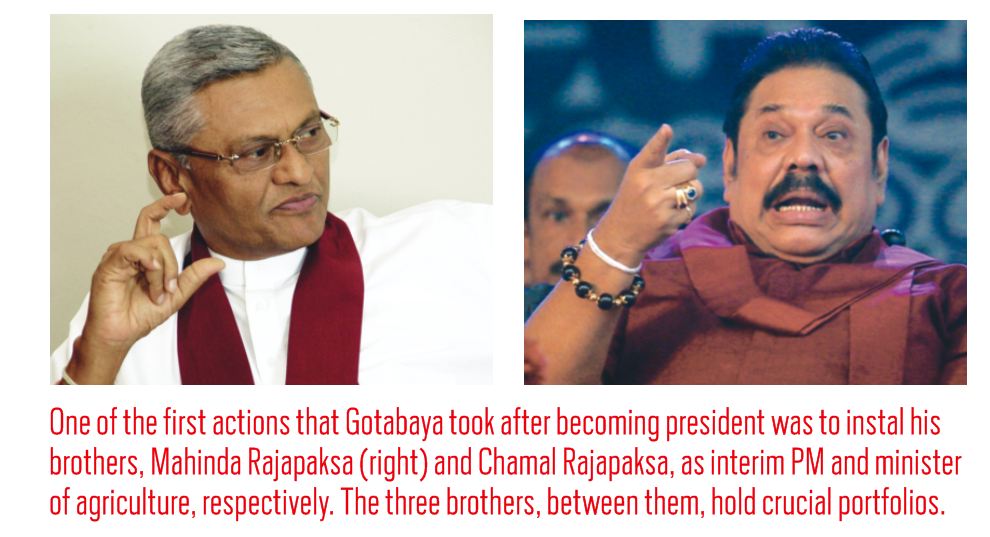
One of the first actions that Gotabaya—who completed two months in office on January 17, 2020—took was to instal his brother, Mahinda, as the interim prime minister even as he placed another brother, Chamal, as the minister of agriculture. The three brothers, between them, control the ministries of defence, public security, finance, economy and policy development, Buddhasasana and cultural and religious affairs, urban development, water supply and residential facilities.
President Gotabaya has acknowledged that the Sinhala majority vote “allowed me to win the presidency”. He will thus come under pressure from the Sinhala majority to deliver upon his pre-election promises. For that, he will need his party, the Sri Lanka Podujana Peramuna (SLPP) to win an absolute majority in the parliamentary polls to be held in March 2020.
In an interview, Gotabaya said that the 19th amendment that curbed the powers of the president was “a failure and if we get 2/3 majority in parliament we will drop it from the constitution”. So in the near term, Gotabaya’s actions will be aimed at securing an absolute majority in the parliamentary elections.
Soon after Gotabaya came to power, there were disturbing trends reminiscent of the past Rajapaksa authoritarian rule, with some smacking of vindictiveness. A Special Presidential Commission (SPC) was appointed to probe those responsible for falsely implicating people in murders or related investigations. State investigative agencies like the Criminal Investigation Department (CID) and the Financial Crimes Investigation Division (FCID) had been investigating a number of cases involving the Rajapaksas.
Even before the SPC probe started, Chief Inspector Nishantha de Silva, head of the organised crimes division of the CID, fled with his family to Switzerland to seek asylum. He was handling high-profile cases involving members of the Rajapaksa family which included important ones like the killing of Lasantha Wickrematunga, the editor of The Sunday Leader. After the police officer fled, there was a nasty backlash when a Sri Lankan woman staffer of the Swiss embassy alleged that she was abducted, questioned and tortured by unknown persons. In the police investigations that followed, the woman was arrested for making false allegations.
The arrest of two former ministers, Dr Ranjitha Senaratne and Champika Ranawaka, of the Sirisena government, who were at the forefront of the campaign to defeat Mahinda Rajapaksa in the 2015 presidential elections, appears to be another example of vindictiveness. While Ranawaka was arrested in a case of accident of 2016 vintage, Senaratne was arrested in connection with a news conference he held two days before the presidential elections in which he produced two persons who claimed to be drivers of white vans that carried out abductions during the Rajapaksa rule. Though both leaders have been released on bail, the action sends a strong message to the opposition that the Rajapaksas will neither forget nor forgive.
Administratively, Gotabaya has shown that he is the master of his own actions. He has introduced steep tax cuts in income tax which he had promised during campaigning. He ordered the removal of portraits of all politicians, including the president and ministers, from the walls of ministerial offices. He drastically pruned defence personnel assigned on presidential and ministerial security duties.
The number of security vehicles accompanying VIP convoys was also slashed and authorities were directed not to hold up traffic on roads unnecessarily when VIP convoys moved. Newly inducted ministers were advised to assume their duties immediately after they were sworn in. Ministers have been advised not to take their spouses when they go abroad on official duties. All these have reinforced his popular image as a man of action.
Unlike his brother, Mahinda, Gotabaya has appointed qualified and experienced persons to head state institutions, instead of political people. Dr PB Jayasundara, an economist, was appointed secretary for revamping the country’s sinking economy. The president has chosen Dr DWD Lakshman, an economist not tainted by the infamous bond scam, as the governor of the Central Bank of Sri Lanka. Similarly, Gotabaya appointed Prince Sarojini Manmatharajah Charles, a senior Tamil civil servant with vast experience, as the governor of the Northern Province. During the conflict in 2009, Charles was in charge of the refugee camps in Vavuniya, housing about 2,90,000 people from the war-torn districts.
The president presented the “Vision for Progress” policy statement when he addressed the parliament for the first time on January 3. Read with his earlier statements, the key elements of the policy include national security concerns, particularly relating to jihadi terrorism, tax cuts and incentives for small and medium enterprises, skill-building, reducing inflation and beefing up economy and actions to “curb corruption and prosecuting the corrupt”. He had also proposed other structural changes to revamp the economy and strengthen security apparatus, including the intelligence set-up.
There is a sense of déjà vu among civil society and minorities who fear that the country could see the return of authoritarianism. P Sampanthan, leader of the Tamil National Alliance, has said the president’s statement that development would be prioritised in resolving the ethnic conflict, would not fulfil the long-standing desire of the Tamils to develop within a united Sri Lanka on their own terms. They are also dismayed at Gotabaya’s assertion that there was “no problem of missing persons to be resolved” except those who fell on the battlefields. This statement neutralises what little progress was made in 2017, when the government created the Office of the Missing Persons to expeditiously deal with cases of missing persons and enforced disappearance.
The Tamils are shocked at the announcement that the national anthem would be sung only in Sinhala and not in Tamil at the Independence Day celebrations in the country. The fringe elements among the Buddhist clergy had welcomed the move. After a lot of public outcry over the issue, the prime minister clarified that no decision had been taken on the issue.
On the international front, the president’s priority appears to be to improve relations with India and Prime Minister Narendra Modi in particular, perhaps to use India to improve his bargaining position with China. He responded positively to Modi’s invitation to visit New Delhi. The invitation was extended soon after he became president. For India, the visit was strategically significant as the Rajapaksas were seen as close to China. Gotabaya needs India’s support to improve national security, combat Islamist terrorism and enable economic recovery. Though Modi had raised the issue of the full implementation of the 13th Amendment giving limited autonomy to Tamils, Gotabaya later said the 13th Amendment could not be implemented “against the wishes and feelings of the majority community”.
China had been watching with concern after Gotabaya during his visit to India termed the agreement with China on the Hambantota Port as a “mistake” and called for it to be negotiated. However, Gotabaya felt the fallout of the statement after returning home. He later told foreign correspondents in Colombo that there was no need to renegotiate the Hambantota agreement but the security aspects needed to be looked into.
Though the Chinese reacted quickly with a statement reminding that the agreement could not be renegotiated, the president is expected to take up the issue of redrafting some clauses of the agreement when he visits Beijing shortly.
Overall, Gotabaya has, by keeping control of key ministries within the dynasty, ensured a tight grip over the country.
—The writer served as the head of intelligence of the IPKF in Sri Lanka. He is associated with the Chennai Centre for China Studies, South Asia Analysis Group and the International Law and Strategic Analysis

Monday, 13 January 2020

Sri Lanka Perspectives: December 2019


Col R Hariharan |31-12-2019| South Asia Security Trends, January 2020


President Gotabaya starts with a bang

President Gotabaya Rajapaksa’s actions in the first 43 days of rule showed he was determined to live up to the popular expectations as a man of action. This comes in sharp contrast to the earlier government which wasted nearly an year witb former President Sirisena and Prime Minister Wickremesinghe busy trying to politically outsmart each other.

President Rajapaksa has set his own style of functioning by picking qualified and experienced persons for heading state institutions rather than filling them with political appointees like his predecessors (including his brother Mahinda). His appointment of Dr PB Jayasundara, an economist, as secretary indicates that revamping the country’s economy would be his priority. Similarly he has chosen Dr DWD Lakshman, an economist not tainted by association with the Central Bank scam as the Governor of the Central Bank. As Indo-Pacific strategic issues are likely to increasingly figure in Sri Lanka’s foreign policy, he has appointed former Navy Commander Admiral Jayanath Colombage as advisor in foreign affairs. 

Similarly, he has appointed Ms Prince Sarojini Manmatharajah Charles, a senior Tamil civil servant with vast experience as Northern Province Governor. During the conflict in 2009, Ms Charles did a commendable job was in charge of the refugee camps in Vavuniya, housing about 290,000 people from the war-torn districts of Vavuniya and Mullaitivu.

President Rajapaksa’s actions are largely in conformity with priorities spelt out in the run up to the presidential election: addressing national security concerns particularly relating to jihadi terrorism, tax cuts and incentives for small and medium enterprises, reduce inflation and beefing up economy and closely orchestrated actions to “curb corruption and prosecuting the corrupt.” There are also other structural revamps in the offing to revamp economy and strengthen security apparatus including the intelligence set up.  

Many of his actions would please the Sinhala nationalist segment that voted him to power. This was evident in the aggressive conduct of some of the fringe elements among Buddhist clergy against other religious minorities. On the other hand, there is a sense of déjà vu among civil society and minorities. 

In a statement, the National Peace Council (NPC) expressed its “concern” at some of the statements by the President. The NPC specifically touched upon three issues.  First related to his statement that development would be prioritized in resolving the ethnic conflict and that strengthening the system of devolution; the NPC said this was “not going to be the answer.”

The second issue was President Rajapaksa’s assertion that there was “no problem of missing persons to be resolved” and limiting it to those who fell on the battlefields. This is a long standing, vexing issue relating to people who went missing not only during the Eelam Wars but also the Janatha Vimukthi Peramuna (JVP) insurrection.  Successive governments had faced the issue without success. 

In 2016, the Sirisena government agreed to issue certificate of absence to relatives of over 65,000 to enable them to gain guardianship of their children and manage property of missing persons. In 2017, the government created the Office of the Missing Persons to  expeditiously deal with cases of missing persons and enforced dis-appearance.  Though President Rajapaksa had only restated the stand of the earlier Mahinda Rajapaksa rule which wished away the issue, he is likely to face political back lash not only at home but also internationally.

NPC’s last point related to the reported statement of minister Janaka Bandara Tennekone who had said the national anthem would be sung only in Sinhala and not in Tamil at the Independence Day celebrations on February 3, 2020. Fringe elements among the Buddhist clergy had welcomed the move. The singing of the national anthem in Tamil was unofficially dropped during Mahinda Rajapaksa rule. But it was restored when Sirisena-Wickremesinghe government came to power.  However, after a lot of criticism over the proposed move the President and PM Rajapaksa have clarified that no decision has been taken on the issue.  

Sri Lanka is required to repay $ 4.8 billion in debt in 2020. So President Rajapaksa’s main challenge will be how to revamp the economy while managing the debt burden. The state-owned the Sunday Observer in a source report said President Rajapaksa had created a new Bureau for National Policies and Plan Implementation. The Cabinet is said to have approved the proposal at its meeting on December 18. This development agency directly under the president will annul earlier state agencies like the National Economic Commission (NEC) and the Strategic Enterprise Management Agency (SEMA).

The Agency would be tasked to achieve the targeted economic growth rate of 6.5% of GDP for the period 2020- 2025. Ambitious targets have been set  to increase per capita income to over US $ 6500, and reduce unemployment to less than 4%, budget deficit to 4% of GDP and cut inflation to 5% respectively. President’s ceremonial speech when the parliament meets on January 3 is likely to focus on how he proposes to achieve his development agenda.

The opposition United Nationalist Party (UNP)-led National Democratic Front (NDF) is in disarray.  Sajith Premadasa, UNP presidential candidate, has accused some of the party leaders working to defeat him rather than help him get elected. The UNP’s internal power struggle between its leader Ranil Wickremesinghe and Sajith Premadasa is yet to be resolved though the former grudgingly agreed to Premadasa heading the party as leader of the opposition in parliament. 

The arrest of former ministers Dr Ranjitha Senaratne and Champika Ranawaka has irked the UNP leadership. Both the leaders were at the forefront of the campaign to defeat Mahinda Rajapaksa when he contested the presidential electon in 2015. While Ranawaka was arrested on a case of accident of 2016 vintage, Senaratne was arrested in connection with a news conference he held two days before the presidential election. He produced two persons who claimed to be drivers of white vans which carried out abductions during the Rajapaksa rule. They also alleged that a large quantity of gold seized from the LTTE was illegally transported to Colombo. However, police investigations have revealed these were false allegations. Though both were released on bail, the arrests were probably intended to send a strong message to the opposition

On the international front, the President is tight rope walking between India and China on the one hand and keeping lines of communication open with the US on the other to access the IMF loan kitty. Rajapaksa’s statement while visiting India, terming the agreement with China on Hambantota Port as a “mistake” and it should be renegotiated had its fall out when he returned home. Speaking to foreign correspondents at a luncheon meeting he said there no need to renegotiate the agreement but the security aspects would need to be looked into. Perhaps the security aspect was behind the appointment of retired General Daya Ratnayake as Chairman of the Sri Lanka Ports Authority (SLPA). We can expect Sri Lanka taking up the issue of redrafting some clauses of the agreement when the President visits Beijing in the third week of January 2020.

Though the President’s clarification on the issue of renegotiation was of some comfort to the Chinese, the embassy statement issued later chose to emphasize the President had made it clear that the Sri Lankan government would not re-negotiate the existing agreement on Hambantota Port and the commercial contract that was signed would not be changed due to change of the government. It reiterated that the security and control of the Port was entirely in the hands of Sri Lanka government and Navy.    

Tail piece: According to a Colombo media report Sri Lanka presidential secretariat was “making plans” to invite Prime Minister Narendra Modi as chief guest for the Independence Day celebrations on February 3, 2020. Yet another act of tight rope walking?
Col R Hariharan, a retired MI officer, served as the head of Intelligence of the Indian Peace Keeping Force in Sri Lanka from 1987 to 90. He is associated with the Chennai Centre for China Studies, South Asia Analysis Group and the International Law and Strategic Analysis. Email: haridirect@gmail.com Blog:: https://col.hariharan.info  


Different Strokes


The killing of General Suleimani on President Donald Trump's orders would probably be classified as an act of terrorism if any country other than the US  had done it.

Col R Hariharan | Global Trends| India Legal January 13, 2020                              https://www.indialegallive.com/world-news/global-trends-news/different-strokes-82371 


The killing of Major General Qasem Suleimani, chief of the Islamic Revolutionary Guards Corps (IRGC)’s Quds Force, considered Iran’s second most powerful leader, by US airstrike last Friday (January 3) in Iraq has taken West Asia to the brink of war. The US operation carried out on the orders of President Donald Trump triggered Iran’s retaliatory military response after three days of national mourning for the slain leader. The Iranians fired two dozen missiles targeting two American bases in Iraq, which do not seem to have suffered much damage.


According to National Interest,  the missiles were area weapons fired from 400 miles away on targets of a few square miles with minimal effect.  This would indicate Iran’s response was calculated to be symbolic to satisfy the masses, baying for revenge. President Trump’s national address on the attack also indicated, at least for the time being, that the US would leave the crisis simmering rather than burst into full-fledged war.  

While strategic analysts continue to debate the cause and effect of the latest US-Iran stand-off, it raises a number of uncomfortable questions on the legality of their conduct. The Quds Force, a part of the IRGC, led by General Soleimani, was responsible for extra territorial unconventional warfare and intelligence. The US designated it a terrorist organization in 2007 with   Canada, Egypt and Saudi Arabia following suit. 

The US had for long held General Suleimani and the Quds Force in its sights for carrying out terrorist attacks through local extremist groups in the Levant.  The US act of carrying out a drone strike to kill Soleimani in Iraq when he was on his way to Baghdad airport , on President Donald Trump's orders, for his alleged role in killing "millions of people," would probably be classified as an act of terrorism, if any country other than the United States had done it.

After the attack,  angry Iranian foreign minister Javad Zarif in a tweet called the US action an act of international terrorism and said it was an extremely dangerous and foolish escalation. “The US bears responsibility for all consequences of its rogue adventurism.

Can the US action be called terrorism? For long, the UN had difficulty in defining terrorism that is acceptable to all member nations.  However, since 1994, the UN General Assembly,  after adopting the 1994 UN Declaration on Measures to Eliminate International Terrorism annexure to UN General Assembly Resoution 49/60 “Measures to Eliminate International Terrorism” of December 9, 1994 uses the following political description of terrorism to condemn terrorist acts:

"Criminal acts intended or calculated to provoke a state of terror in the general public, a group of persons or particular persons for political purposes are in any circumstance unjustifiable, whatever the considerations of a political, philosophical, ideological, racial, ethnic, religious or any other nature that may be invoked to justify them.” 

By this UN definition of  terrorist act,  the killing of General Suleimani may fall under the above category of terrorist act.

Other than this, UN’s international conventions on anti-terrorist measures for various sectors, ARE based on operational definition of the specific type of terrorist act. These measures focus on action by non-state actors and adoption of a criminal law enforcement model under which states would cooperate in the apprehension and prosecution of those who committed the terrorist act.

Though the UN has had difficulty in defining terrorism, the US defines terrorism in Title 22 Chapter 38 U. S. Code § 256f as "premeditated, politically motivated, perpetrated against noncombatant targeted by sub national groups or clandestine agents."  So the act of killing Suleimani by using an air strike  may not pass muster in the US as an act of terrorism.

In April 2019, in a questionable move the US designated the IRCG, a constitutional entity of the Iranian government, a terrorist organization. This was said to have been opposed by the Central Intelligence Agency.  The IRCG is distinct from the Iranian army which is entrusted with national security. The IRCG’s role is protecting the Islamic system, to prevent foreign interference and coups by the military or other opposition movements. Evidently the US action was taken to check IRCG activities in Syria, Iraq, Palestine and Lebanon.

Mary Ellen O’Connell, research professor of international dispute resolution, at the University of Notre Dame, in her comments to the CNN held that Trump’s decision to kill General Suleimani was not legal as it had the quality of an act of revenge, reprisal and punishment.  She cited the President’s Twitter that General Suleimani “was plotting to kill many more….but got caught…” and “he should have been taken out many years ago” and the Department of Defense press release calling the attack “a defensive action”.

Moreover, under the right of self-defence,  military attack is permitted under UN Charter Article 51 only “if an armed attack” occurs on the defending nation. The triggering action must be significant and the response necessary and proportionate to halt and repel the ongoing attacks. So Prof  O’Connell holds the killing of Suleimani cannot be justified by the law of self-defence.

Her comment “Trump is not the first president to carry out drone killings in violation of international law. He has taken the practice to a new level of lawlessness” says it all.

The writer is a military intelligence specialist on South Asia, associated with the Chennai Centre for China Studies

Thursday, 2 January 2020

ஜெனரல் பிபின் ராவத் முப்படைகளின் தளபதியா?; கேள்வி & பதில்


கர்னல் ஆர் ஹரிஹரன்

ஜெனரல் பிபின் ராவத் CDS ஆக நியமிக்கப் பட்டதை பற்றி  ஒரு தமிழ் பத்திரிகையாளரின் கேள்விகளுக்கு நான் அளித்த விடைகளை கீழே அளித்துள்ளேன் :

1.   முப்படைகளுக்கும் ஒரே தளபதி' என்பதற்கான தேவை என்ன, இவருடைய பணி என்னவாக இருக்கும்?

போர் கலை 20-21ம் நூற்றாண்டுகளில் மகத்தான வளர்ச்சி அடைந்துள்ளது. சேடலைட் மற்றும் கம்பியூடர் ஆகியவற்றின் தொடர்ந்து அதிகமாகும் உபயோகம் உலக அளவில் செய்திகளின் பரிமாற்றத்தில் புரட்சி ஏற்படுத்தியுள்ளது. ஆகவே தற்காலப் போரில் எதிரிகளை எதிர் கொள்ள முப்படைகளும் ஒருங்கிணைந்த சேவை செய்வதற்கான கட்டாயம் ஏற்பட்டுள்ளது. அந்த ஒருங்கிணைப்பாளராக CDS செயல்படுவார். ஆகவே அவரை ராணுவ அல்லது விமான மற்றும் கடற்படைத் தலைமைத் தளபதிகளின் தளபதி என்று கூறுவது தவறு.

இந்திய எல்லையில் ஏற்பட்டுள்ள பாதுகாப்பு சூழ்நிலையில் பெரும் மாற்றங்கள் ஏற்பட்டுள்ளன. இதற்கு முக்கிய காரணம் இரண்டு அணு ஆயுத அரசுகள் - பாகிஸ்தான் மற்றும் சீனா - இணைந்து செயல்படுவதற்கான பாதுகாப்பு ஒப்பந்தங்கள் ஆகும். 

இதுபோலவ இந்திய பெருங்கடலில் சீன கடற் படையினரின் பிரவேசம் வலுத்து வருகிறது. இது இந்தியா மட்டும் அல்லாமல் மற்ற உலக வல்லரசான அமெரிக்கா மற்றும் அதன் நேச நாடுகள் மத்தியில் கலக்கத்தை ஏற்படுத்தியுள்ளது. 

ஆகவே தனியாக செயல்பட்ட இந்தியாவுக்கும் அமெரிக்காவுக்கும் முன்னெப்போதும் இல்லாத நெருக்கமான பாதுகாப்பு உறவுகள் சென்று பத்தாண்டுகளில் உருவாகியுள்ளது. ஆகவே இந்திய முப்படைகள் பல நாடுகளுடன் ஒருங்கிணைந்த பயிற்சி செய்து வருகின்றன. ஆகவே CDS இத்தகைய திட்டமிட்ட செயலாக்கங்களை உருவாக்குவதில் பாதுகாப்பு அமைச்சருக்கும் பிரதமருக்கும் ஆலோசகராக செயல்படுவார். 

2. தற்போது ஜனாதிபதி தான் முப்படைகளின் தளபதியாக உள்ளார். இந்தப் புதிய பதவி ஜனாதிபதியின் அந்தஸ்தை குறைக்கிறதா?

நான் ஏற்கனவே CDS முப்படைகளின் தளபதி அல்ல என்பதற்காகன காரணங்களை முதல் கேள்வியின் விடையில் அளித்துள்ளேன். ஆகவே CDS  பதவி ஒரு விதத்திலும் ஜனாதிபதியின் அந்தஸ்தை குறைக்காது. அதற்கு மாற்றாக ஜனாதிபதிக்கு தேவையான போது CDS-க்கு போர்நிலையைப் பற்றிய விளக்கம் கூறும் கடமையும் இருக்கும் என்பது என கணிப்பு. 

3. புதிதாக நியமிக்கப்பட்டுள்ள பிபின் ராவத், இராணுவத் தளபதியாக இருந்தபோது பல சர்ச்சைக்குரிய அரசியல் கருத்துகள் தெரிவித்ததாகவும், ஆளும் தரப்புக்கும் நெருக்கமானவர் என்கிற குற்றச்சாட்டு உள்ளது? இவரது நியமனத்தை நீங்கள் எப்படிப் பார்க்கிறீர்கள்?

அவர் 38 ஆண்டுகள் ராணுவத்தில் பல்வேறு அழுத்தம் மிக்க சூழ்நிலையில் அடிமட்டத்தில் ஆரம்பித்து உயர் பதவிகளில் பணியாற்றியவர். அவ்வாறு பணியாற்றும் பல்லாயிரக்கணக்கான ஆபீசர்களில் இருந்து ராணுவத் தலைமைப் பதவியில் பணியாற்றியவர். ஆகவே நான் அவரை மெத்தனமாக ஊடக முறையில் அவர் தனிப்பட்ட கருத்துக்களை விமர்சிக்க விரும்பவில்லை. 

4. பாதுகாப்பு படைகளின் அதிகாரம் ஓரிடத்தில் குவிவதாக இதன்மீது ஒரு பார்வை வைக்கப்படுகிறது. இதன்மூலம் மக்களாட்சிக்கு அச்சுறுத்தல், இராணுவ ஆட்சி வந்துவிடும் என்கிற குற்றச்சாட்டுகளுக்கு உங்களுடைய பதில் என்னவாக இருக்கும்? 

 இந்திய ஜனநாயகத்தைக் காப்பாற்ற சென்ற 70 ஆண்டுகளில் ராணுவப் படைகள் செய்த மகத்தான தியாகங்களை மறந்து அரசியல் ஒன்றே பிழைப்பு என்று செயல்படுவோர்களின் பிதற்றல் என்றே இந்தக் கருத்தைக் கூறுவேன். இந்திய ராணுவம் இன்றும் தனது முழுத்திறனுடன் செயல்படவிடாமல் இருப்பதற்கு இத்தகைய மனநிலையில் பதவியில் இருப்பவர்களே காரணம். 


Tuesday, 17 December 2019

Putting on the thinking cap: Thoughts on India and Sri Lanka


Col R Hariharan | December 10, 2019 | 

Courtesy: FPRC Journal 2019(4): Focus: India-Sri Lanka Relations post 2014;               
 [Here are my answers to questions raised by Foreign Policy Research Centre, New Delhi on India-Sri Lanka relations post 2014]

Q-1: Sri Lanka’s perceptional issues:

a. Is it correct to say the fear of Indian domination runs deep in the Sri Lankan psyche, although a section of leaders and the intelligentsia want close ties with India?

b. The ‘ethnic question’ in Sri Lanka, even after the defeat of the Liberation Tigers of Tamil Eelam (LTTE), evokes a sense of suspense, uncertainty and even a possible conflict of interest in the otherwise robust and multifaceted relationship between India and Sri Lanka. Do you agree?


The three questions sum up Sri Lanka’s perception of India at three levels: “Big brother syndrome” of smaller neighbours of India including Sri Lanka, bilateral issues of potential confrontation and multilateral issue in international forum.  India because of its huge size, economic power, population and military strength is seen as Big Brother in Sri Lanka. So every action India takes that might affect Sri Lanka is critically analysed by Sri Lanka media and in almost all political parties there are sections highly critical of real or imaginary Indian domination.

But the two countries share almost identical racial and socio-cultural life. Sinhala majority are believed to have originated from Northern India who migrated and settled in Sri Lanka from 543 BCE to 243 BCE. According to the Sri Lankan chronicles Emperor Ashoka’s son Mahinda introduced Buddhism in Sri Lanka in 4th century BCE and brought a sapling of sacred Bodhi Tree. Sri Lanka is considered the only Buddhist nation to have maintained uninterrupted Theravada Buddhist tradition for over 1600 years. Many devout Sri Lankans associate India as the land of Buddha; so it is not surprising that only 4 percent of Sri Lankas had a negative view on India –the lowest of all countries surveyed – according to Ipsos Global Scan survey quoted in Wikipedia.  

However, after independence the rise of Sinhala nationalism and Tamil quest for preserving their identity, language and traditional habitations degenerating into separatist militancy divided the society on ethnic lines. India’s active support to the Tamils after the 1983 anti-Tamil pogrom in Sri Lanka and refuge offered to Tamil insurgent groups and Indian military intervention in Sri Lanka from 1987 to 90 and its aftermath adversely affected Sri Lanka-India relations. India had taken a tough stand against the LTTE during the Eelam War. It continues prevent anti-Sri Lanka extremist groups to operate from Indian soil.  Both the countries have since then tried to overcome the bitterness left in the wake of ethnic conflict. India’s successive governments have tried to build upon the positive developments; this has to an extent resulted in India downplaying the ethnic question. This has largely been reciprocated by Sri Lanka. As both the nations appear to be aware of each other’s sensitivity more than ever before, we can expect their bilateral relations to grow closer and deeper.

Q-2: It appears only Tamil Nadu has a disagreement with Sri Lankans, while the rest of the country supports the bilateral trade and economic relations with Sri Lanka. Regional parties have their own compulsions. Their demands and protests are intended to pander to their vote-banks. While the Centre needs to keep in mind the rationale (and underlying sentiment) of these demands when formulating policy, it should not allow regional parties to dictate diplomatic engagements. How far do you agree?

The question appears to be based on wrong premises and misconceptions about Tamil Nadu’s geographical, cultural, religious, linguistic and historic ties with Sri Lanka for nearly 2000 years. In fact, Tamil King Rajaraja Chola-I defeated  Anuradhapura Kingdom in 993 AD. His son King Rajendra Chola conquered most of Sri Lanka and by 1017 AD incorporated it as a province of the Chola Empire. During British colonial days, Tamil labour was taken to Sri Lanka to work on tea plantations owned by the British.

After Sri Lanka gained independence its refusal to grant Sri Lankan citizenship to Tamils of Indian origin (locally known as Plantation Tamils) became a contentious issue between Sri Lanka and India till it was resolved subsequently. In 1956 Sri Lanka Tamil minority launched the struggle to preserve their identity, language and traditional habitations in the face of rising tide of Sinhala Buddhist nationalism. There is widespread sympathy for their struggle in Tamil Nadu since then. So Tamil sentiments cannot be trivialized as “disagreement.” From time immemorial, fishermen from Tamil Nadu and Sri Lanka have been fishing in Palk Strait. However, the delineation of the India–Sri Lanka maritime boundary and the Tamil separatist war started, Indian fishing in Sri Lanka waters  became yet another confrontation between the two countries.

As far as trade relations are concerned, it is incorrect to say that Tamil Nadu does not support bilateral trade and economic relations with Sri Lanka. On the contrary, despite all the political polemics in the state, Tamil Nadu occupies the top slot in Indo-Sri Lanka trade. Exim Bank of India Working paper on Indo-Sri Lanka Trade and Investment Relations published in March 2018, had estimated that 40 percent of India’s total trade with Sri Lanka takes place through Tamil Nadu as Sri Lankan exports to India enter through Chennai Port.

Equitable treatment Sri Lanka Tamil minority and welfare of people of Indian origin in Sri Lanka have always continued to be part of India’s Sri Lanka policy. The signing the India-Sri Lanka Agreement (ISLA 1987) by Prime Minister Rajiv Gandhi with President JR Jayawardane on July 29, 1987 was aimed at resolving the issue of Tamil autonomy within a united Sri Lanka. Even during the coalition days of Dr Manmohan Singh’s government, New Delhi had not wholly allowed regional parties of Tamil Nadu to “dictate diplomatic engagements” with Sri Lanka. In spite of pressure from Tamil Nadu coalition partners, New Delhi had provided diplomatic, political, intelligence and limited military support to Sri Lanka to defeat LTTE Tamil separatists in Eelam War (2006-09). 

Q-3: Why the long-standing dispute between India and Sri Lanka over fishermen crossing maritime boundaries remains unresolved? It is baffling to note that political actors in Tamil Nadu make a hue and cry over human rights violations of their counterparts in Sri Lanka, yet when it comes to the fishermen issue they take exactly the opposite stand, against the interest of Sri Lankan Tamils.

Traditionally, both Indian and Sri Lankan fishermen have been fishing in the Gulf of Mannar and Palk Bay seas for centuries. However, after India and Sri Lanka signed a maritime agreement in 1974 and the maritime boundary was delineated. In 1976, India and Sri Lanka agreed to stop fishing in each other’s waters after political confrontation between Sri Lanka state and Tamil leaders started worsening. Though the agreement on fishing was in force it could not prevent Tamil fishermen from fishing in Sri Lankan waters. Meanwhile, Tamil Nadu took up trawl fishing in a big way. This was in violation of Sri Lankan laws on use of trawl nets. It endangered marine depleting fishing stock. So, often Indian trawlers in search of catch violated the International Maritime Boundary Lines. Similarly, Sri Lankan fishermen, though in lesser numbers, often entered Indian waters entered in search of Tuna fish.

Sri Lanka banned fishing in Gulf of Mannar and Palk Strait after Eelam war broke out in 1983. Sri Lanka naval boats patrolling the waters frequently confronted Tamil Nadu fishermen poaching in Sri Lankan waters arrested them and seized their boats. The continuing fishermen’s confrontation became a major political issue in Tamil Nadu. After the Eelam war ended in 2009, Sri Lanka lifted the ban on fishing by Sri Lankan Tamil fishermen. It is estimated that at any time more than 500 trawlers from Tamil Nadu cross the maritime boundary and fish in the Sri Lankan side of the Palk Bay, threatening the livelihoods of the fishermen of North Sri Lanka, Frequently, this has resulted in direct confrontation between fishermen from both sides. They were encouraged to hold direct talks to find a solution; however it failed to yield any solution because their livelihood depends on fishing.  The problem continues because there is no political will on both sides to resolve the issue. There is no correlation between the fisherman issue which is livelihood related and the Tamil human rights violations issue related to ethnic confrontation.

Q-4: It is argued relations with India and China are “not a zero sum game” and Colombo’s expanding relations with China are not in any way a “contradiction” to that. Is Colombo playing cheeky with two huge regional powers a sensible strategy for an island nation like Sri Lanka?

ow owes US$ 8 billion for the projects executed by China. To partly settle the Chinese deb, Sri Lanka  handed over to China the control of the $ 1.6 billion Hambantota port,  strategically located on the Southern tip of the island. Similarly, China has just completed the Phase 1 of the Colombo Port City project costing $ 1.5 billion to be built on reclaimed land in close proximity of Colombo port, through which 70 per cent of India’s container traffic passes. India has been watching these developments with concern as it has whittled down India’s strategic influence not only in Sri Lanka, but the IOR as a whole.

Sri Lanka, with ever increasing Chinese presence in its midst on the one hand, and located in close proximity of India with which it has multifaceted relations on the other, is hardly in a position to be “cheeky” with two giant Asian powers’ IOR power play. The newly-elected President Gotabaya Rajapaksa chose to visit India first to improve his equation with New Delhi to enable him to strengthen Sri Lanka’s balancing act with China.

Q-5: "Often, we have heard the Indian leaders emphasising the need for Sri Lanka to ensure that the Sri Lankan soil is not used by any third party that would pose a threat to India. Similarly, we too would want India to ensure that...any groups operating within Indian soil does not pose a threat to Sri Lanka," Sri Lanka's opposition leader Mahinda Rajapaksa said  (February 9,2019)  Your comments.

Mahinda Rajapaksa, now Prime Minister, was making a political statement in the run up to the presidential election on what the two countries had already agreed. India and Sri Lanka had actually agreed on this issue in ISLA 1987 and PM Rajiv Gandhi’s letter to President Jayawardane attached to the ISLA 1987. The ISLA is still valid and both countries are, by and large, adhering to its stipulations.

PM Gandhi’s letter lists issues on which the two leaders have agreed to take action. Points relevant to the question are covered vide Paragraphs 2(i) and 2(ii) of the letter given below:
       i.            Your Excellency and myself will reach an early understanding about the relevance and employment of foreign military and intelligence personnel with a view to ensuring that such presences will not prejudice Indo-Sri Lankan relations.
     ii.            Trincomalee or any other ports in Sri Lanka will not be made available for military use by any country in a manner prejudicial to India's interests.

So Sri Lanka has already agreed in principle, not to make available for military use of Trincomalee or any other port by any country “in a manner prejudicial to India’s interest.”  Presumably this also applies to Hambantota or Colombo.
Similarly, India vide Paragraphs 2.16(a) and 2.16(b) of ISLA 1987 is committed to following actions:
i.                   Para 2.16(a): India will take all necessary steps to ensure that Indian territory is not used for activities prejudicial to the unity, integrity and security of Sri Lanka.
ii.                 Para 2.16(b): The Indian navy/coast guard will cooperate with the Sri Lankan navy in preventing Tamil militant activities from affecting Sri Lanka.

Q-6: There is now mention of Sri Lanka joining hands with India and Japan on the ‘security front’ too. If true, there needs to be clarity and clarification if Sri Lanka would be the fifth arm of the emerging quadrilateral Indian Ocean security alliance involving the original four, or would be independent of it. Your assessment.

It is too early to speculate upon the future shape of the Quadrilateral alliance involving the US, Japan, Australia and India, which is still in formative stage.  The first ministerial level meeting of the four countries has been held only recently.  Expansion of China's strategic reach in Indo-Pacific has become a major concern for the US and its allies. India is also equally concerned at China’s expanding footprint in South Asia and IOR, weakening India’s strategic influence in the region. 

However, India has always been cautious in joining the Quad grouping lest it upset India’s relationship building with China. However, as China-Pakistan strategic alliance is firming up, India has limited options. So despite its aversion to sacrifice autonomy in foreign policy making, India has joined the Quad which is still a work in progress.  At present, both India and China appear to be keen to mutually benefit from each other’s strengths rather than confront each other. As they are aware of each other’s sensitivities in Sri Lanka and IOR, they are more likely to maintain status quo. In this environment there is no incentive for Sri Lanka to join the Quad; in any case, Quad members also may not be open to admit Sri Lanka.  


PM Narendra Modi’s foreign policy has continued to prioritise neighbouring countries.  In Sri Lanka, he has tried to build bridges with the Sinhala Buddhist segment by emphasizing on the Indian religious connection.  He has tried to keep windows of communication open with all political segments of Sri Lanka. In the last days of President Mahinda Rajapaksa’s rule India’s relations soured a bit due to Sri Lanka’s tilt in favour of China. However, PM Modi has not allowed it affect his readiness to build cordial relations with President Gotabaya Rajapaska. This has been warmly reciprocated.  As PM Modi has a reputation of a result oriented leader, we can expect Sri Lanka to maintain close contacts at the highest level to meet the demands of nation’s criticalities.